
|
PLAYHORSE
•
OUTLAWS & ADVENTURE
VIRGINIA
|
She knew the men who controlled the gambling houses, racetracks, nightclubs and illegal fortunes of America. She traveled with their money, attended their parties and moved between rival organizations at a time when a misplaced word could prove fatal. Yet Virginia Hill was far more than the girlfriend of Benjamin "Bugsy" Siegel. She was one of the most talked-about women of the American underworld, a colorful and controversial figure whose remarkable journey stretched from the Great Depression through the golden age of Hollywood, the rise of Las Vegas and the Senate's great organized-crime investigations.
1916–1933 The Alabama Girl Who Wanted More
Virginia Hill was born on August 26, 1916, in Lipscomb, Alabama, near Birmingham. Her father, Mack Hill, traded horses and mules, an occupation that offered little guarantee of prosperity in the rural South. Virginia grew up in a large family with limited means and few obvious opportunities for the kind of life she wanted.
As a teenager, she escaped the restrictions of her upbringing through an early marriage. By 1933, at just seventeen, she had made her way to Chicago, a city whose reputation was still inseparable from Al Capone, Prohibition and organized crime.
Chicago was hosting the Century of Progress World's Fair, a magnificent exhibition celebrating industry, invention and the possibilities of modern life. Beneath the optimism, however, the city still contained the powerful criminal organizations that had flourished during Prohibition.
Virginia found work around the fairgrounds and later as a waitress at the San Carlo Italian Village, a restaurant frequented by men connected to the Chicago Outfit. One of those men would change the direction of her life.
1934 Joe Epstein and the Racetrack Money
Joseph Epstein was a bookmaker and financial operator associated with the Chicago mob. He worked in the world of gambling, collections and bookkeeping, where enormous amounts of cash circulated outside ordinary banking channels.
Epstein noticed Virginia's confidence, quick mind and willingness to take chances. Before long, she became involved in his gambling business, including operations connected to horse racing.
According to historical accounts, Virginia was entrusted with substantial cash wagers at Chicago racetracks, sometimes involving thousands of dollars on a single race. Epstein's schemes used betting and the subsequent handling of winning tickets to help account for money generated by criminal enterprises.
She learned how gambling profits, financial records and the appearance of legitimate winnings could be used in the underworld. For a young woman who had grown up with little money, the sums must have seemed extraordinary.
Her racetrack experience would become a curious feature of her life. Nearly twenty years later, when United States senators demanded to know how she had accumulated so much money, Hill would point to winnings from betting on horses as one explanation.
It was a story that connected two very different worlds: the respectable excitement of thoroughbred racing and the less respectable financial arrangements of the Chicago Outfit.
1930s Diamonds, Furs and Dangerous Deliveries
Virginia's usefulness to the criminal underworld was not limited to racetrack betting. Accounts of her career describe her carrying large sums of money, valuable jewelry and stolen merchandise between cities.
A stylish young woman wearing fashionable clothes and traveling first-class could attract a very different sort of attention than a heavily guarded gangster carrying a briefcase. Virginia reportedly learned to use that distinction to her advantage.
Epstein helped finance an increasingly extravagant lifestyle. Expensive dresses, jewelry, beautiful furs and hotel accommodations became part of her daily existence. She began associating with powerful figures in the Chicago Outfit, including Frank Nitti and Charles Fischetti.
Hill was not a Mafia boss commanding soldiers or issuing orders to criminal crews. Her influence came from her personal relationships, mobility and ability to operate among men who rarely trusted outsiders. She became a familiar presence in circles where money, gambling and violence were closely connected.
NEW YORK CITY A Romance with Joe Adonis
Her travels eventually took her to New York, where the criminal landscape included powerful figures such as Charles "Lucky" Luciano, Frank Costello and Joe Adonis.
Adonis was an influential racketeer with interests in illegal gambling and other criminal businesses. Virginia developed an affair with him, and historical accounts describe her involvement in transferring money and gathering information connected to his operations.
New York offered the atmosphere Virginia enjoyed: fashionable hotels, expensive restaurants, Broadway entertainment and the company of wealthy men who appeared to have unlimited spending money.
But this was also a world governed by personal loyalty, jealousy and suspicion. Rivalries between the men in her life could turn violent, and Virginia's ability to move between criminal factions was useful precisely because such relationships were dangerous.
LATE 1930s Hollywood, George Raft and the Brown Derby
Virginia eventually gravitated toward Hollywood, where her social life began to include actors, producers, entertainers and wealthy businessmen.
One of the most interesting connections was actor George Raft, whose own remarkable career began among the gangsters and nightclubs of New York. Raft had known Bugsy Siegel for years, making him a natural connection between the Los Angeles entertainment community and the underworld.
Historical accounts place Virginia and Siegel together at Raft's Los Angeles home in 1939. The later Hollywood movie Bugsy dramatized their introduction on the set of Raft's 1941 film Manpower, but evidence suggests their acquaintance began earlier.

Virginia also attracted the attention of Errol Flynn, one of Hollywood's most famous leading men. According to accounts of her adventures, the two became involved in an argument during a date at the Brown Derby, the celebrated Los Angeles restaurant where movie stars regularly gathered.
The incident made its way into the gossip columns. For Virginia, celebrity was beginning to come almost as naturally as money, although she had never achieved fame through a successful movie career.
She was now moving comfortably between the Beverly Hills Hotel, fashionable restaurants and private gatherings attended by people who were famous, feared or sometimes both.
THE GREAT ROMANCE Bugsy Siegel Enters Her Life
Benjamin "Bugsy" Siegel was handsome, charismatic and ambitious. He was also a ruthless gangster whose criminal partnerships reached back to his youth in New York.
Siegel had become a major figure in Southern California's illegal gambling and bookmaking operations. His associations included Meyer Lansky, Lucky Luciano and other powerful members of the national criminal underworld.
Virginia and Bugsy developed a passionate and turbulent relationship marked by extravagant spending, jealousy, fierce arguments and repeated reconciliations.

Siegel showered Virginia with gifts and helped finance an expensive lifestyle. She traveled, entertained and wore jewelry and fashionable clothing that attracted considerable attention.
Yet the romance was far from a Hollywood fairy tale. Contemporary accounts and later histories describe frightening arguments and physical violence in their relationship. The same criminal connections that supported their luxurious lives also created extraordinary personal risks.
1945–1947 The Birth of the Flamingo
Bugsy Siegel had enormous ambitions for Las Vegas, a relatively small desert city where gambling was legal and the potential for luxury tourism was largely unexplored.
The Flamingo hotel and casino was originally conceived by Hollywood businessman and publisher Billy Wilkerson. Siegel subsequently became involved, obtained financing through his underworld connections and took control of the project.
The goal was to create an elegant resort with glamorous accommodations, fashionable entertainment, high-stakes gambling and a level of sophistication unlike anything previously seen in Las Vegas.

The Flamingo opened on December 26, 1946, before its hotel accommodations were fully completed. George Raft was among the Hollywood personalities associated with the opening festivities. The casino's early financial performance was disappointing, and Siegel's investors grew increasingly concerned about mounting construction expenses.
Virginia spent time with Siegel in Las Vegas but reportedly disliked the desert and the tensions surrounding the unfinished project. She later told Senate investigators that she advised him to sell the property because operating it had become so stressful.
THE LAS VEGAS LEGEND Was the Flamingo Named After Virginia?
One of the most frequently repeated stories about Virginia Hill claims that Bugsy Siegel named the Flamingo after her. According to the legend, he called her his flamingo because of her red hair and striking appearance.
It is a charming story, but the historical evidence points elsewhere. The Flamingo name was associated with Billy Wilkerson's resort project before Siegel assumed control, and recent research disputes whether Virginia was ever commonly known by that nickname.
Another version connects the name to the flamingos at Hialeah Park in South Florida, where Siegel was said to have taken an interest in horse racing. The various explanations have become intertwined with the mythology of early Las Vegas.
What cannot be disputed is that the Flamingo, Virginia Hill and Bugsy Siegel became permanently linked in the public imagination.
1940s Mexico, Hollywood and Secretive Connections
Virginia's adventures were not confined to the United States. She traveled frequently to Mexico and maintained contacts in the country's social and political circles.
Her ability to speak Spanish and cultivate influential acquaintances made her interesting to criminal organizations looking to expand their connections across borders.
Senate investigators later associated her with suspected narcotics operations linked to the Chicago Outfit. But those allegations require caution. Later examination of federal narcotics records has not established that Hill personally directed drug trafficking, despite claims made about her at the time.
Her reputation grew from a combination of genuine criminal associations, romantic relationships, financial activity and speculation. She undoubtedly knew many important people in the underworld. Precisely how much she knew about every operation remains a question historians continue to examine.
JUNE 20, 1947 Murder at the Beverly Hills Mansion
The most dramatic event in Virginia Hill's life occurred when she was thousands of miles away.
By June 1947, Hill's relationship with Siegel had become increasingly strained. She departed for Europe, ultimately reaching Paris. Her trip would later become the subject of persistent speculation about whether she knew trouble was coming.
On the evening of June 20, Siegel was sitting inside Virginia's rented Beverly Hills residence at 810 North Linden Drive. A gunman outside fired through a window, killing him.
The murder shocked Hollywood and became one of the most notorious unsolved killings of the twentieth-century American underworld.
Many theories have connected Siegel's death to disputes over money, his costly handling of the Flamingo and discontent among his criminal associates. No one was convicted of the murder.
Virginia was in Paris when Siegel was killed. Her absence immediately generated rumors that she had received a warning or deliberately left before the shooting. Such theories have circulated for decades, but the historical record does not establish that she knew in advance what would happen.
In an instant, the man who had financed much of her glamorous lifestyle was gone, and the house in which he died became an enduring landmark in organized-crime history.
AFTER BUGSY Miami, the West Coast and a New Life
Siegel's death changed Virginia's position in the world. The luxurious surroundings and the money associated with her former life did not disappear overnight, but the security she had enjoyed became increasingly uncertain.
She continued traveling and spent time in Florida, including Miami, where Siegel had reportedly financed a house for her. She also lived in the American West, maintaining connections with some of the same associates who had supported her for years.
By the late 1940s, federal investigators were paying closer attention to Hill's finances. The government wanted to know how she had acquired expensive possessions, received enormous sums of cash and maintained a lifestyle seemingly inconsistent with her reported income.
1950 A Romance on the Ski Slopes
One of the strangest turns in Virginia's life began at Sun Valley, Idaho, the fashionable mountain resort popular with Hollywood celebrities and wealthy vacationers.
There she met Hans Hauser, an Austrian skiing champion and instructor. Their romance developed rapidly, and the couple married in 1950.
It was a remarkable change in circumstances. After years of associating with gangsters, gamblers and movie personalities, Virginia was now married to a professional skier whose world revolved around mountains rather than casinos.
Their son, Peter, was born later that year. For a time, family life seemed to offer a possible escape from the scandal and danger that had surrounded her.
But the past was not prepared to disappear.
MARCH 1951 The Queen of the Mob Faces the Senate
In 1951, Virginia Hill was called to testify before the United States Senate's Special Committee to Investigate Organized Crime in Interstate Commerce, chaired by Senator Estes Kefauver.
The televised hearings became a national sensation. Millions of Americans watched as notorious gambling figures and underworld personalities answered questions about their businesses, finances and criminal associations.
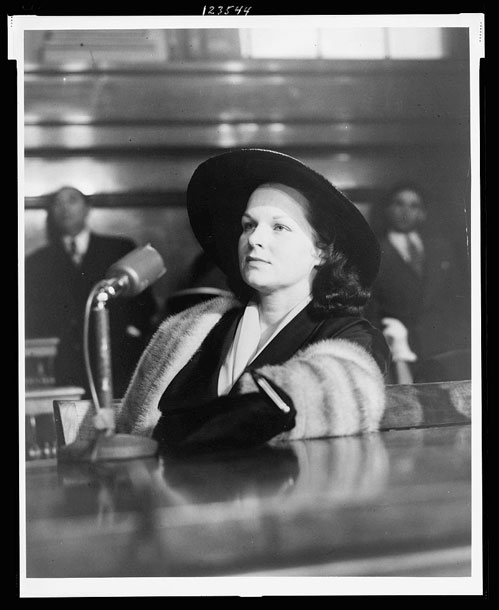
Virginia arrived at the New York hearings wearing a broad-brimmed hat, silk gloves and an expensive fur cape reportedly valued at $5,000. Photographers and television cameras immediately recognized the possibilities of presenting a glamorous woman as a central figure in the nation's organized-crime investigation.
The senators wanted answers about her connections to figures such as Joe Adonis, Meyer Lansky and Bugsy Siegel. They also wanted an explanation for the considerable sums of money that had passed through her hands.
Hill insisted she knew little about her associates' criminal activities. She said that men she had known gave her money and expensive gifts. She also claimed substantial income from betting on horse races.
Her answers often frustrated investigators, and her colorful personality became an immediate attraction for the press. The hearing itself was more controlled than some later dramatizations suggest, but her encounters with aggressive reporters afterward were considerably less restrained.
Outside the hearing room, photographers crowded around her. She angrily confronted members of the press, including slapping and kicking at journalists. The confrontation became part of the spectacle surrounding her testimony.
Overnight, Virginia Hill became a national celebrity. Her photograph appeared in newspapers across America, and the public suddenly knew the face of the woman so closely associated with Bugsy Siegel and the criminal underworld.
1951–1950s The Government Comes for the Money
Virginia's Senate appearance did little to satisfy federal tax investigators. The Internal Revenue Service pursued her for unpaid income taxes associated with the substantial funds she had received over the years.
In 1951, federal agents seized a house she owned in Spokane, Washington, as part of efforts to collect a tax bill reported at approximately $161,000. Virginia found herself facing a government far less impressed by her expensive clothes and famous acquaintances than the nightclub patrons of Hollywood and New York had been.
Her husband also encountered immigration difficulties, further complicating the couple's attempt to establish a stable family life in the United States.
Gradually, Virginia and her family moved toward a more permanent life in Europe. Austria offered a quieter environment, but the fame and notoriety she had acquired in America could not be completely left behind.
1960s The Final Years in Austria
By the early 1960s, the life Virginia had known in America was mostly a memory. Bugsy Siegel had been dead for more than a decade. Some of her former associates were imprisoned, exiled or increasingly distant from the criminal world that had once supplied her with extraordinary amounts of money.
Living in Austria, she faced financial difficulties and personal troubles. The years following Siegel's death had also included serious emotional crises and previous episodes of self-harm.
On March 24, 1966, Virginia Hill was found dead outdoors near a stream in the countryside outside Salzburg, Austria. She was forty-nine years old.
Austrian authorities concluded that she had died by suicide following an overdose of sedatives. Rumors quickly circulated that she had been murdered because of secrets she might have known about organized crime, but no credible evidence has established that theory.
The contrast was profound. The woman who had once entertained Hollywood celebrities, traveled with wealthy racketeers and appeared before the United States Senate in luxurious furs had spent her final years far from the glittering world that made her famous.
HER LEGACY More Than Bugsy Siegel's Girlfriend
Virginia Hill has remained a compelling figure in American organized-crime history because her life connects so many colorful worlds: Depression-era Chicago, New York gambling syndicates, the golden age of Hollywood, Las Vegas casinos, horse racing, luxurious resorts and international travel.
Her life inspired books, documentaries and fictional portrayals. Annette Bening played a glamorous, dramatized version of Hill opposite Warren Beatty's Benjamin Siegel in the 1991 motion picture Bugsy.
Yet the real Virginia Hill remains more elusive than the Hollywood versions. Some stories portrayed her as an indispensable financial operator in the national mob. Others presented her merely as an attractive woman who benefited from powerful lovers. The evidence suggests a more complicated figure: a trusted associate who performed useful work in the criminal underworld, while much about her actual influence remains uncertain.
The glamour was genuine, as were her underworld connections. So were the risks. The same associations that provided wealth and excitement also exposed her to violence, suspicion, government investigations and personal instability.
Virginia Hill never commanded a pirate ship, robbed a stagecoach or became a Hollywood leading lady. Her adventure was of a different kind. She crossed America carrying the money and confidences of dangerous men, lived among movie stars, watched the rise of Las Vegas and survived the murder of one of the country's most notorious gangsters. She seemed to possess everything that made the underworld seductive: money, travel, expensive clothes, beautiful hotels and powerful friends. But her story also revealed the terrible price that could come with such a life. Few women traveled so far from such modest beginnings, and few left behind a legend quite so difficult to separate from the truth.