PLAYHORSE · Offshore Performance Boats

Six Legendary Offshore Powerboats That Defined the Go-Fast Era

Long, narrow hulls. Massive marine engines. Thundering exhaust notes and the ability to run through offshore chop at extraordinary speeds. The classic American go-fast boat became a symbol of South Florida wealth, offshore racing and the Miami Vice era. From Don Aronow's legendary Cigarette Racing boats to the offshore machines built by Donzi, Fountain, Apache and Wellcraft, these six models helped establish the modern performance-boating lifestyle. Each has a distinctive racing heritage, loyal following and place in American powerboat history.

Blue and white Cigarette 38 Top Gun offshore racing powerboat running at high speed over open water with a long deep-V hull and twin-engine performance configuration
Cigarette 38 Top Gun underway. Image: BoatTEST.

The definitive offshore Cigarette

01 Cigarette 38 Top Gun

Length: 37'6" Beam: 8' Deep-V: 24°

Few names are more closely associated with offshore performance boating than Cigarette. Founded by legendary offshore racer Don Aronow in 1969, Cigarette Racing helped turn high-speed powerboats into an international luxury lifestyle.

The 38 Top Gun became one of the marque's most recognizable models. Its long, low profile, sharply pointed bow and narrow beam established the classic look of a serious offshore go-fast boat.

Designed around a deep-V running surface, the Top Gun could maintain impressive speeds while handling the choppy conditions encountered in coastal waters. Twin Mercury Racing engines supplied the power, with different generations offering a range of engine packages.

A 2004 performance test recorded 86.4 mph with twin Mercury Racing HP525EFI engines. More recent versions feature updated construction, electronics and cockpit accommodations while preserving the model's distinctive profile.

The Top Gun's reputation extends beyond speed. Its connection to Thunderboat Row, bold custom paint schemes and muscular engine note make it one of the defining American offshore performance boats.

Explore the Cigarette 38 Top Gun
Original Miami Vice-style Wellcraft Scarab 38 KV offshore powerboat with dark blue hull, turquoise accent stripes, long pointed bow and Miami waterfront in background
The restored Miami Vice Scarab. Image: Barche a Motore.

The television icon

02 Wellcraft Scarab 38 KV

Length: 37'7" Beam: 8'6" Deep-V: 23°

No offshore powerboat captured the atmosphere of 1980s Miami quite like the Wellcraft Scarab 38 KV.

The boat became internationally famous through the television series Miami Vice, where Don Johnson's Sonny Crockett piloted a distinctive dark-blue Scarab with turquoise accents across the waterways of South Florida.

The Scarab succeeded the Chris-Craft Stinger used earlier in the series and became closely associated with the show's mixture of undercover police work, fashionable nightlife and exotic automobiles.

The original model measured 37 feet 7 inches and used a race-derived deep-V hull. Wellcraft's period specifications listed twin MerCruiser 420-horsepower engines, although equipment and power varied among boats and production years.

Beneath the deck was a surprisingly accommodating cabin with sleeping quarters, seating and a small galley.

The Scarab 38 KV also had genuine offshore racing credentials, giving its television fame a mechanical foundation. Today, surviving examples in original Miami Vice-inspired colors attract enthusiasts of both classic powerboats and 1980s popular culture.

Discover the original Miami Vice Scarab
Historic 1984 Apache 41 Warpath offshore racing powerboat with tan and blue hull, number 69 racing graphics and open competition cockpit
1984 Apache Warpath. Image: DeRemer Studios.

The offshore racing thoroughbred

03 Apache 41

Length: 41' Kevlar construction Straight deep-V hull

If the Cigarette helped establish the luxury image of offshore performance boats, the Apache 41 represented their uncompromising racing character.

The model was developed during the 1980s through the work of offshore boatbuilder Bobby Saccenti and other prominent figures in Miami's high-performance marine industry.

The 41-foot Apache became known for its strong construction, narrow profile and ability to maintain speed in difficult offshore conditions.

One of the most famous examples, Warpath, won the American Power Boat Association World Championship in Key West in 1984.

The heavy-duty straight deep-V hull provided a different approach from the lighter stepped-bottom designs that became popular in later years. Many Apaches incorporated Kevlar reinforcement and powerful twin or triple inboard installations.

Distinctive hull names, dramatic paint schemes and offshore racing histories have made individual Apache boats important pieces of powerboat collecting.

For enthusiasts of the rough-water racing era, the Apache 41 remains one of the most respected designs to emerge from South Florida.

Explore Apache racing heritage
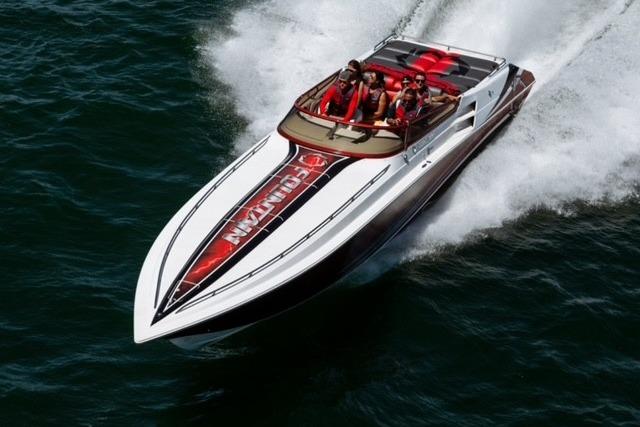
White Fountain 42 Lightning offshore performance powerboat with red and black racing graphics, open cockpit and twin-engine deep-V hull running at speed
Fountain 42 Lightning underway. Image: YachtWorld.

Reggie Fountain's speed machine

04 Fountain 42 Lightning

Length: 42' Stepped-V hull Twin inboards

Reggie Fountain built his reputation by using offshore racing as a laboratory for performance-boat engineering.

The Fountain 42 Lightning became one of the most recognized results of that philosophy.

Its long, narrow hull incorporated Fountain's Positive Lift running-surface technology, using steps and a carefully developed keel design to improve efficiency and high-speed handling.

The model combined a deep cockpit, dramatic racing graphics and powerful twin inboard engines with a small cabin suitable for short trips.

In a period performance test, a 42 Lightning fitted with upgraded Mercury Racing power reached 112 mph. That was a particularly powerful test configuration, not a universal top-speed figure for the model.

The Lightning also developed an important offshore racing legacy. Specially prepared 42-foot Fountain race boats helped establish major V-bottom speed records during the early 2000s.

The 42 Lightning remains one of the best-known American performance boats, with its combination of racing heritage and luxury appointments.

Fountain has also announced a redesigned 42 Lightning for 2027, retaining the celebrated running-surface concept while updating the deck, cockpit and cabin.

Explore the Fountain 42 Lightning
White and red Donzi 38 ZR offshore go-fast powerboat with a long narrow fiberglass hull, open performance cockpit and twin MerCruiser stern drives
Donzi 38 ZR. Image: Ray White Marine.

A modern Donzi deep-V classic

05 Donzi 38 ZR

Approx. 38'10" Beam: 8'8" Twin stern drives

Donzi has been one of the most important names in American performance boating since Don Aronow established the company in 1964.

Decades later, the Donzi 38 ZR carried that racing heritage into a more modern era.

Its low, elongated body, narrow beam and deeply sculpted cockpit created the familiar profile of a serious offshore go-fast boat.

The ZR used a fiberglass deep-V running surface designed for high-speed performance, with twin Mercury Racing power commonly found in the engine compartment.

One documented 2008 example fitted with twin 525-horsepower Mercury Racing engines was advertised with a maximum speed of approximately 85 mph.

The cabin offered useful accommodations without compromising the boat's performance-oriented silhouette.

The 38 ZR also helped establish a design language continued by Donzi's later ZRC models, including the revived 38 ZRC performance boat.

Its appeal lies in a combination of traditional Aronow-era offshore styling and more contemporary engine, control and construction technology.

See the Donzi 38 ZR specifications
Cigarette Racing 42X offshore performance powerboat with an elongated deep-V hull, low racing cockpit and twin high-performance marine engines
Cigarette Racing 42X offshore powerboat. Image hosted in the PLAYHORSE gallery.

The modern V-bottom flagship

06 Cigarette Racing 42X

Length: 41'7" Beam: 8' Up to 2,700 hp

The Cigarette Racing 42X represents a modern interpretation of the offshore powerboats that made the company famous.

Its appearance remains unmistakably Cigarette: a long, narrow hull, sharply pointed bow, deep cockpit and an engine compartment designed to accommodate enormous power.

But underneath the familiar profile is a substantially updated engineering package.

Cigarette developed a revised deep-V hull capable of handling high-powered twin-engine installations while maintaining stability and rough-water control.

The 42X features a 24-degree deadrise and an eight-foot beam, preserving the proportions associated with classic offshore go-fast boats.

Available engine configurations have included twin Mercury Racing 1100 and 1350 models, giving the most powerful versions a combined rating of up to 2,700 horsepower.

The cockpit incorporates modern electronics, performance seating, advanced materials and premium interior finishes.

Despite its technical sophistication, the 42X still delivers the unmistakable appearance and driving experience that made Cigarette one of the world's most recognizable performance-boat brands.

Explore the Cigarette Racing 42X

Thunderboat Row: Where the American Go-Fast Boat Became a Legend

The history of American offshore performance boats is inseparable from North Miami's legendary Thunderboat Row.

During the 1960s, 1970s and 1980s, the Northeast 188th Street corridor near Biscayne Bay became an international center for the development and construction of high-speed powerboats.

One of the central figures was Don Aronow, a former New Jersey real estate developer who became an offshore racing champion and influential boat manufacturer.

Aronow founded several important marine businesses, including Donzi, Magnum and Cigarette Racing. His achievements helped establish an entirely new market for luxury performance boats.

Miami's offshore boating scene attracted wealthy entrepreneurs, professional racers, entertainers and other colorful personalities.

During the same era, go-fast boats became associated with South Florida's notorious drug-smuggling history. Their speed and offshore capabilities made them attractive for illicit transportation, although the marine industry itself served a much broader community of recreational owners and professional racers.

By the 1980s, offshore powerboats had become part of Miami's international image.

Television shows such as Miami Vice turned high-performance boats into recognizable symbols of the city's waterfront lifestyle.

The Wellcraft Scarab, Cigarette and other performance boats appeared in magazines, advertising campaigns and television productions around the world.

Meanwhile, professional offshore racing continued to push manufacturers toward improved hull construction, stronger engines and more advanced propulsion systems.

The work of builders including Reggie Fountain, Bobby Saccenti and Mark McManus helped extend the sport's technical achievements.

Today, offshore performance boating continues through poker runs, racing championships, collectors' gatherings and specialist marine manufacturers.

Classic deep-V powerboats also remain highly visible at Florida boating events, particularly in the Miami, Fort Lauderdale and Florida Keys markets.

Performance note: Speed and horsepower figures refer to specific tested boats or available engine configurations. The same hull model may have been sold with several power packages, and later restorations or engine replacements can change performance substantially.

What Makes a Cigarette-Style Offshore Powerboat Different?

The defining feature of the traditional offshore go-fast boat is its long, narrow, deep-V hull.

Unlike many conventional pleasure boats, these designs emphasize high-speed performance, directional stability and the ability to navigate rougher open-water conditions.

The V-shaped bottom helps the boat cut through waves rather than simply riding flat across the surface.

Many classic offshore models use deadrise angles in the low-to-mid-20-degree range, although hull geometry differs considerably between manufacturers.

Power is commonly supplied by twin high-performance gasoline engines driving sterndrives, often supported by sophisticated steering and trim systems.

Modern stepped-hull designs introduce additional engineering complexity by changing the contact between the running surface and the water.

The steps can reduce drag and improve efficiency, but they also require precise design and skilled operation.

Catamarans represent a different performance category, using two narrow hulls rather than one deep-V bottom.

For this PLAYHORSE selection, the focus is specifically on the classic monohull offshore performance boats associated with Cigarette Racing, Thunderboat Row and the American offshore racing tradition.

Their appeal is as much about design, heritage and mechanical character as outright maximum speed.