
PLAYHORSE • Outlaws & Adventure
Buddy
Jacobson
Never the Quiet Life
Fast horses, Manhattan models, a ski lodge in Vermont and a getaway through a jail’s front door. The restless life of a Brooklyn original.

Some men reinvent themselves once. Howard “Buddy” Jacobson seemed unwilling to stop. Horse trainer, property owner, modeling-agency operator and, eventually, fugitive: he moved between lives that would hardly seem to belong to the same man. The racing pages knew him before the crime reporters did.
1930s–1950s A Brooklyn Beginning
Born in Brooklyn in 1930, Buddy had an introduction to racing that most aspiring horsemen could only envy. His mother’s family included the Jacobs brothers, with celebrated trainer Hirsch Jacobs among his uncles. By his early twenties, Buddy was a licensed trainer himself. The family connections opened a door; keeping horses in the winner’s circle was another matter.
His particular territory was the claiming game, where horses can change owners for an advertised price. It rewards an eye for overlooked ability and a willingness to make a decision before everyone else agrees with it. Buddy built a substantial career there, eventually becoming the nation’s leading trainer by victories in 1963.
1963 The Bargain That Beat Them
Consider Bupers. Marion Frankel bought the colt from Ogden Phipps for $16,500. Trained by Buddy, he won the 1963 Futurity at Aqueduct, collecting $90,974 in first-place money. Jockey Avelino Gomez lost a stirrup in the stretch and still got him home in front. A horse who had recently appeared in a claiming race had beaten the opposition in a major stakes event. That was a result worth considerably more than a good sales pitch.
Buddy also enjoyed needling the establishment. Anthony Haden-Guest reported that, after a purchase irritated Phipps, Buddy proposed naming the horse “Ogden Flips.” Evidently, winning was not always enough; sometimes he wanted the last word, too.
1969 Making Trouble at Aqueduct
In 1969, Jacobson led a nine-day Aqueduct boycott demanding improved pensions and benefits for backstretch workers. The shutdown belongs to the history of the people who kept racing operating, not simply its better-dressed spectators. The dispute also put Buddy’s appetite for confrontation on public display: he was prepared to challenge the institution in which he had made his living.
That same spring, his name appeared in another challenge to racing’s established order. On March 14, Barbara Jo Rubin rode Bravy Galaxy to victory at Aqueduct at odds of 13–1, becoming the first female jockey to win a race in New York.
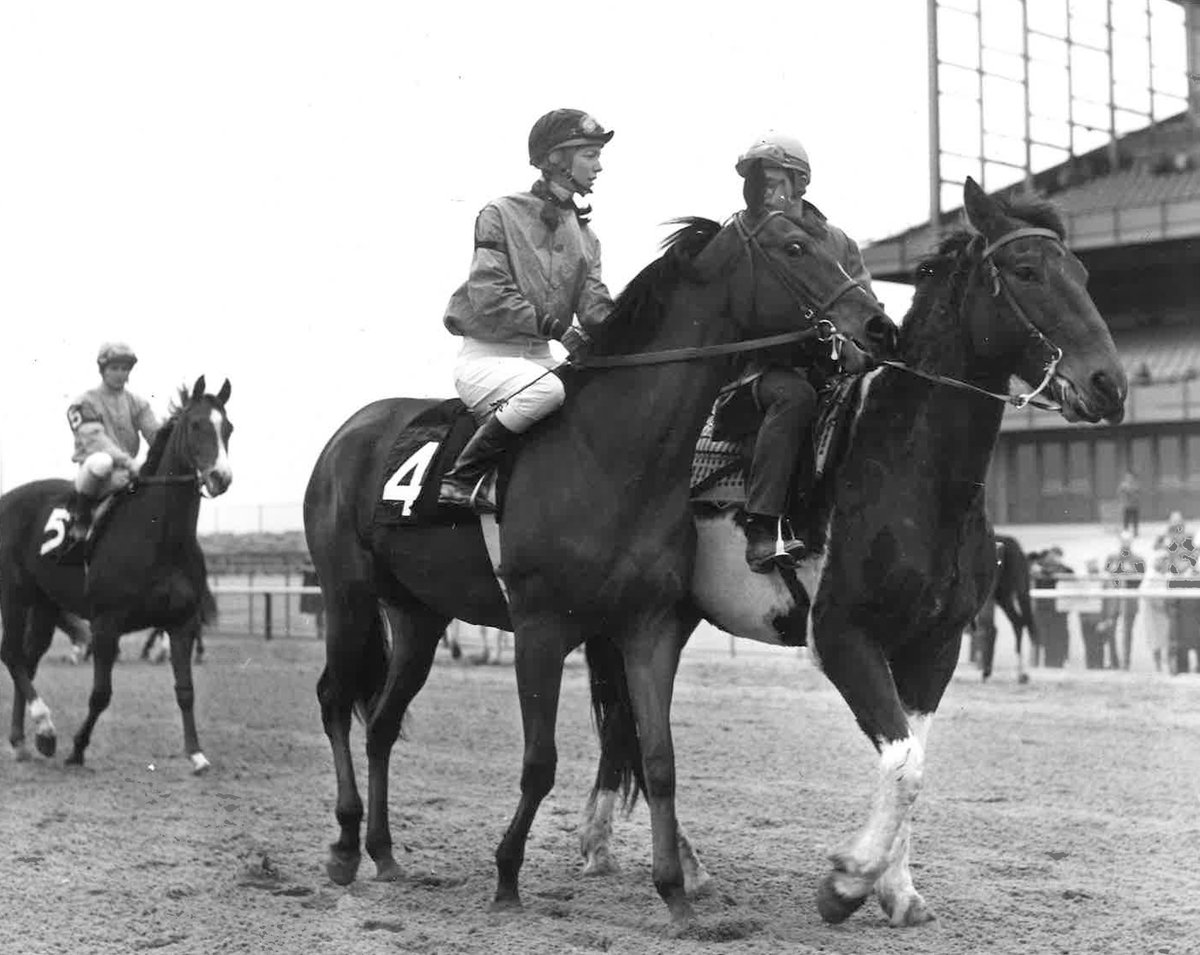
The distinction matters: NYRA’s account identifies Bryan Webb as the horse’s actual trainer, with the entry running under Jacobson’s name to avoid trouble with racing authorities. Rubin did the riding, Webb prepared the horse, and Buddy’s name was part of the arrangement. Racing history is more interesting when everyone gets the right credit.
Beyond the Racetrack The Vermont Detour
Then there was the Norway, a ski lodge near Vermont’s Mount Snow. In his 1978 profile, Haden-Guest described Buddy’s involvement in the venture and associates’ memories of his restless romantic life. One remembered an eccentricity particularly ill-suited to winter sports: Buddy would ski without socks. He apparently brought his own rules to the slopes.
1970s Models, Buildings & East 84th Street
Manhattan supplied the next setting. Buddy owned 155 East 84th Street and operated My Fair Lady with model Melanie Cain, his business partner and lover. Across the street was Nicola’s, where journalist Anthony Haden-Guest remembered encountering him. Horses had given way to apartments, models and restaurant tables.

There is something almost absurd about the range of these enterprises. A claiming stable and a modeling agency do not require the same expertise. Neither resembles a Vermont lodge. Yet each offered a fresh opportunity to become the man making the decisions. Looking back, that seems the more revealing connection than glamour alone.
1978–1980 Where the Party Ended
Cain’s relationship with restaurateur John “Jack” Tupper brought a bitter rupture. Haden-Guest’s later account described Buddy offering Tupper $100,000 to leave her.
Tupper was murdered on August 6, 1978. After an eleven-week trial, Jacobson was convicted on April 12, 1980. He maintained his innocence, but the conviction brought a sentence of 25 years to life.
This is where an entertaining catalogue of escapades becomes something else. Tupper was a real person whose life ended violently, not a supporting character placed in Buddy’s path. Any honest account has to hold that fact alongside the racing success, the audacity and the stranger-than-fiction episodes that followed.
May 1980 Out Through the Front Door
On May 31, before sentencing, Buddy escaped from the Brooklyn House of Detention. As TIME reported, his acquaintance Anthony DeRosa arrived posing as an attorney. During the visit, Buddy changed his appearance and emerged in a suit as the supposed lawyer. He walked out. DeRosa remained behind, and the deception was discovered afterward. There was no tunnel or helicopter: the escape depended on being mistaken for someone entitled to leave.
Summer 1980 Westbound, Under Another Name
With model Audrey Barrett, he drove west, sleeping in motels and camping along the way. According to TIME’s account of the flight, the pair even borrowed names from gravestones in Des Moines. It was less Riviera hideaway than roadside improvisation.
A later Los Angeles Times profile recalled him posing as a writer and roller-skating along the beach.
The ending came at the Criterion Restaurant in Manhattan Beach. Buddy ordered fried zucchini with Parmesan, then called New York from a pay phone. Investigators traced the call. Police arrived while he was still talking, bringing roughly forty days on the run to an end.
The Final Years No Further Reinvention
Returned to custody, Jacobson spent his remaining years serving his sentence. He died of cancer in 1989, aged 58. There would be no return to the paddock and no further change of profession.
His story resists the easy labels. Calling him merely a horse trainer leaves out most of it. Calling him merely a fugitive misses the substantial career that came first. Calling him a lovable rogue would be worse: it would ask the reader to overlook the murder conviction that cannot honestly be separated from his name.
What remains is a remarkable, deeply troubled American life: talent, nerve, money, reinvention and consequences. Buddy Jacobson could spot an opening in a claiming race, a business venture or a guarded doorway. Finding an opening, however, was never the same thing as knowing where it would lead.
From the archives to the screen: Buddy Jacobson’s life is the subject of the film project Buddy from Brooklyn. Further historical background: Jacobson biography, the 1969 Aqueduct dispute, and the University of Virginia Law Library’s trial summary.