Some cars become famous for a speed record. Others change what a sports car can be. These 12 exotic supercars earned their place through engineering, design and the way they made people feel. From the Lamborghini Miura and Ferrari F40 to the McLaren F1 and Bugatti Veyron, PLAYHORSE revisits the machines that shaped supercar history and still stop a conversation when they pull up.
The Lamborghini Miura helped establish the shape of the modern supercar. Unveiled in 1966, it tucked a transverse V12 behind the seats and wrapped the machinery in Bertone bodywork that still looks extraordinary. Its low nose and sweeping rear haunches gave a road car the proportions of a racing machine.
The Miura also understood the value of an entrance. Its appearance in the opening of The Italian Job made it a film icon, but the engineering mattered just as much as the glamour. This is where Lamborghini’s reputation for mid-engine exotica took hold.
The Lamborghini Countach turned the exotic car into a cultural event. Its wedge-shaped body and scissor doors looked outrageous when the concept appeared in 1971. By the time production began in 1974, Lamborghini had created a silhouette that would define the supercar poster for a generation.
A V12 mounted lengthwise behind the cockpit supplied the substance. Later versions added wider arches and larger engines, while an appearance in The Cannonball Run carried the fantasy onto the screen. Few cars have made standing still look so theatrical. The photograph shows the later 5000QV.
The Porsche 959 looked familiar enough to underestimate. Under its 911-like outline sat a twin-turbo flat-six, electronically controlled all-wheel drive and sophisticated suspension. The production model appeared in 1985, with series production following in 1987. Much of what later became standard supercar thinking was already taking shape here.
Developed from Porsche’s Group B ambitions, the 959 made technical intelligence part of the attraction. Its ability to bring power, traction and chassis control together gave it a different kind of presence. This was a supercar for people who wanted to know what was happening beneath the bodywork.
The Ferrari F40 announces its intentions with a fixed rear wing and a body that seems pulled tight around the machinery. Introduced in 1987 to celebrate Ferrari’s 40th anniversary, it paired a twin-turbo V8 with extensive use of composite materials. Enzo Ferrari attended the unveiling, connecting the occasion directly to the company’s founder.
The appeal is easy to understand: very little about the F40 feels decorative. Its Pininfarina design puts the mechanical purpose on display, and its stripped-back character gives the car a lasting identity. Among classic Ferrari supercars, it remains a particularly persuasive argument for keeping things raw.
The Jaguar XJ220 looks as though it was drawn in one uninterrupted movement. Its long aluminum body and covered headlights gave Britain a distinctive answer to the Italian supercar establishment. Developed with Tom Walkinshaw Racing, the production car reached customers in 1992 with a twin-turbo V6 and rear-wheel drive.
The specification had changed considerably from the 1988 concept, but the visual impact survived. A five-speed manual gearbox kept the experience firmly rooted in its era. Today, the XJ220’s appeal lies in those proportions and in the ambition of a Jaguar that ventured far beyond the grand-touring brief.
The McLaren F1 put its driver in the middle, with a passenger seat to either side and slightly behind. Revealed in 1992, it combined that unusual cabin with a carbon-fiber structure and a naturally aspirated BMW V12. Everything about the arrangement made the driver feel central to the car’s purpose.
The reputation was reinforced on the circuit when the racing F1 GTR won the 24 Hours of Le Mans outright in 1995. That distinction belongs to the competition version, but it adds a remarkable chapter to the family story. Few supercars combine such original thinking with such convincing racing credentials.
The Pagani Zonda arrived at the 1999 Geneva Motor Show with no long-established badge to do the talking. Horacio Pagani’s first production supercar paired a Mercedes-Benz V12 with a carbon-fiber structure and bodywork influenced by endurance racing. The forward cabin and dramatic curves gave it an identity of its own.
The Zonda’s importance goes beyond introducing another exotic Italian car. It made the choice of materials and the treatment of individual components part of the spectacle. The original C12 established a philosophy that still defines the marque: engineering should reward a close look as much as the finished shape does.
Naming a car after Enzo Ferrari left little room for an ordinary result. Introduced in 2002, the Enzo brought a six-liter V12, carbon-fiber construction and carbon-ceramic brakes to Ferrari’s road-going flagship. Its pointed nose made the connection to the company’s Formula 1 program visible before anyone opened the engine cover.
Developed with input from Michael Schumacher, the Enzo reflected a period when Ferrari’s confidence on the circuit was shaping its ambitions on the road. It marks an important step between the mechanical directness of earlier flagships and the more integrated electronic systems of the modern hypercar.
The Porsche Carrera GT makes its strongest argument through the controls. A naturally aspirated V10 sits behind the occupants, while a six-speed manual gearbox keeps the driver closely involved. First shown as a concept in 2000, it entered production in 2003 with a carbon-fiber monocoque and substantial racing influence.
The engine’s roots lay in Porsche’s abandoned Le Mans prototype program, giving the car a story that extends well beyond the showroom. Its place among the great supercars rests on that combination of advanced construction and direct participation. The Carrera GT asks the driver to be part of the performance.
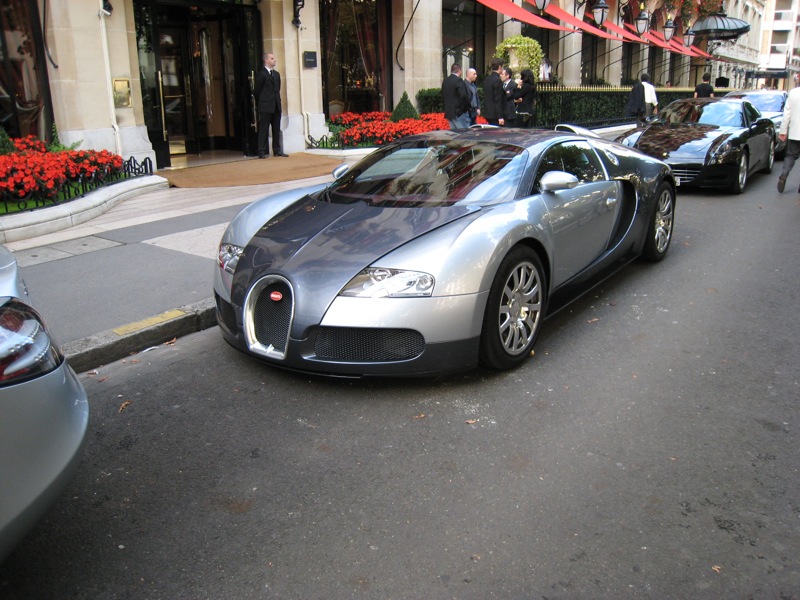
The Bugatti Veyron 16.4 changed the scale of the supercar conversation. When production began in 2005, its eight-liter W16 and four turbochargers delivered 1,001 PS, roughly 987 horsepower. The achievement involved much more than producing a dramatic number: cooling, tires and transmission all had to support the ambition.
Bugatti also wanted the comfort expected of an exceptional luxury car. Bringing those demands together helped define the modern hypercar, where immense performance and a carefully finished cabin could share the same brief. The rounded body and horseshoe grille gave a formidable engineering project a face that was unmistakably Bugatti.
The Lamborghini Aventador carried the visual drama of the Countach into a new century. Introduced in 2011, the original LP 700-4 combined a naturally aspirated V12 with a carbon-fiber monocoque. Its scissor doors and sharply drawn body ensured that the engineering arrived with the expected sense of occasion.
A screen appearance as Bruce Wayne’s car in The Dark Knight Rises suited it perfectly. The Aventador represents a distinctive chapter in Lamborghini history: advanced construction wrapped around the enduring theater of a large V12. It earns its place for keeping that tradition vivid while moving the structure underneath it forward.
LaFerrari brought hybrid technology to Ferrari’s flagship while keeping the V12 at the center of the experience. Unveiled at Geneva in 2013, it combined a 6.3-liter engine with the HY-KERS electric system. Together they produced 963 CV, approximately 950 horsepower, with the electric motor strengthening response at lower engine speeds.
Active aerodynamics helped manage the performance, making the body part of the car’s moving technical story. LaFerrari deserves its place because it showed how electrification could serve the supercar’s appetite for acceleration. It opened a new chapter for Ferrari without giving up the engine that had defined so many of its great road cars.