
PLAYHORSE • Outlaws & Adventure
Don
Aronow
The King of Thunderboat Row
World championships, celebrity passengers, bruising test runs and boats that became objects of desire. The extraordinary life of the man behind Formula, Donzi, Magnum and Cigarette.

Retirement was a poor fit for Don Aronow. He had made money on dry land and could have spent the rest of his life enjoying it. Instead, he went looking for speed, found offshore powerboat racing and helped turn a stretch of South Florida waterfront into an international address for horsepower. The boats were beautiful. The competition was vicious. And the man selling the dream was usually willing to take the first ride.
1927–1950s Before the Engines
Born in Brooklyn in 1927 to Russian-Jewish immigrant parents, Aronow worked as a Coney Island lifeguard and served in the Merchant Marine before making his fortune in New Jersey construction. His early career included a brief spell teaching physical education. By the time he settled in Florida, he had already learned how to turn an opportunity into a business. What he needed next was something that did not feel like work.
1962 The Race That Hooked Him
The 1962 Miami–Nassau race supplied the answer. Encouraged by his fishing friend Forrest Johnson, Aronow entered the offshore contest and finished fourth after mechanical trouble spoiled his chances. A respectable result for a newcomer, perhaps, but hardly the sort of ending that would satisfy him. Rather than remain a customer buying somebody else’s boat, he began pursuing the machinery—and the people—that could put him in front.
The Early Formula Days A Test Ride to Remember
Boatbuilder Allan “Brownie” Brown later described a Formula test run that makes a persuasive case for letting someone else evaluate the prototype. Aronow took Brown, Jake Trotter and Stu Jackson out in a barely finished boat, with little to hold onto and an exposed engine. According to Brown, they struck a large cruiser’s wake at about 55 miles per hour. The boat launched, rolled in the air and came down hard.
Two of the men went to the hospital. Brown and Aronow nursed the damaged boat back toward the factory, themselves injured, with its displaced control box secured by rope. Brown remembered Aronow turning to him with a smile and asking, “Well, what do you think of it?” It is a survivor’s recollection, told years afterward, but the question captures a man still assessing the product while the blood was drying.
1960s Building His Own Competition
Formula, Donzi and Magnum Marine followed one another through Aronow’s hands. He would establish a company, make its boats desirable and sell the business, then find another opportunity. Northeast 188th Street became the setting for this remarkable succession of launches, both nautical and financial.
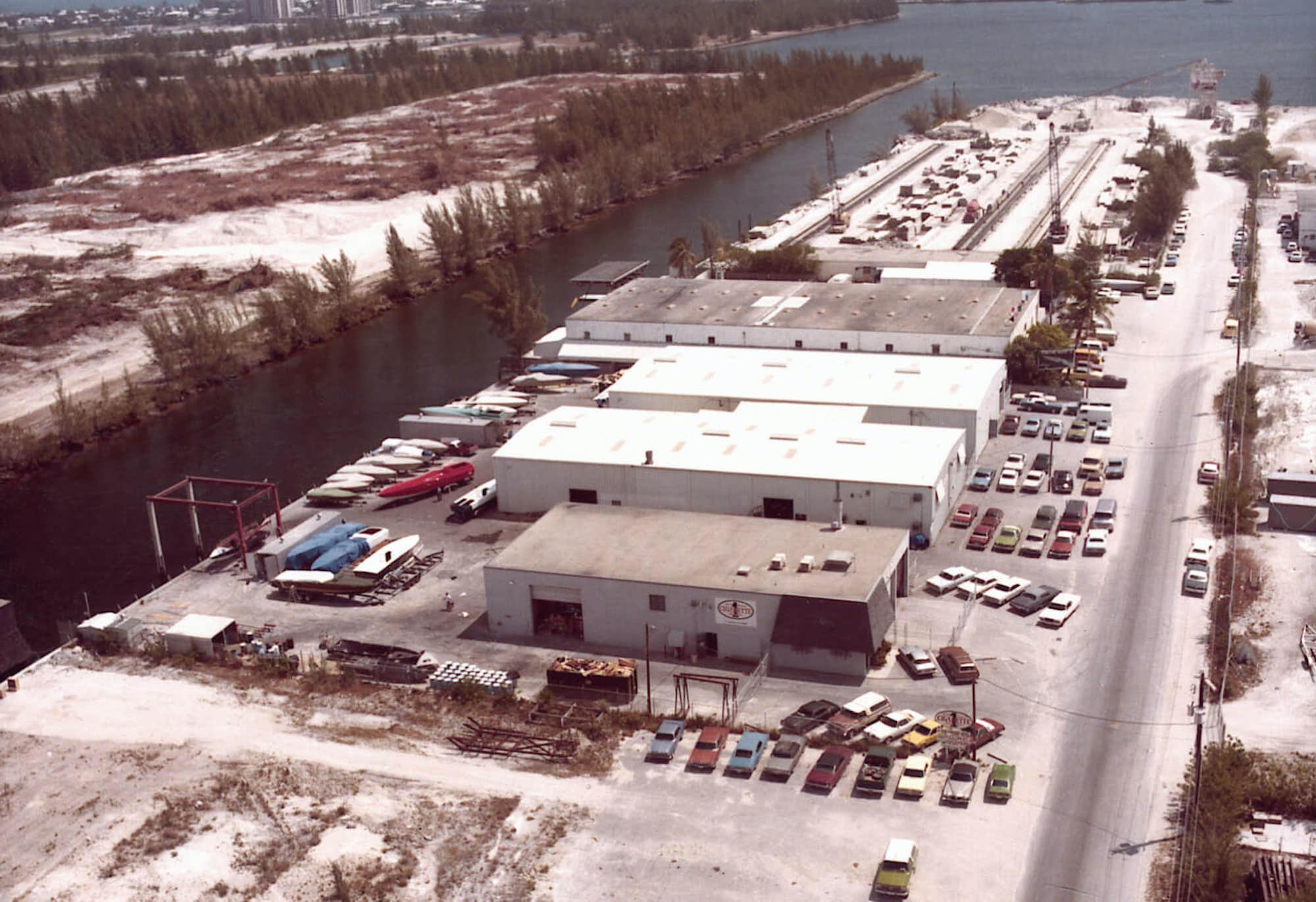
His son Michael recalled a particularly pointed piece of real estate strategy: after selling Donzi, Aronow erected the Magnum building on neighboring land, obscuring the earlier factory from the highway. In Michael’s account, even the architecture reflected his father’s competitive streak.
1964 A Boat Full of Beatles
There were gentler outings, too. During the Beatles’ 1964 Miami visit, Aronow and his son Michael shared a boat ride with the band, an encounter preserved in archival photographs. For a man building a name in pleasure boating, it was an enviable passenger list.

The Racing Years 007 & the Winner’s Circle
The celebrity photographs were good publicity, but the racing results carried more weight offshore. His Donzi racer 007 won the Miami–Nassau race, helping establish the young brand’s reputation. Behind the handsome boats stood skilled collaborators, including designers Jim Wynne and Walt Walters, engine specialist “Pop” Meekins and riding mechanic Norris “Knocky” House. Aronow supplied the ambition; he did not do everything alone.
He won the world offshore championship in 1967 and again in 1969. These were titles earned across an international racing campaign, not simply by turning up for one successful afternoon. Whatever anyone thought of his manners or sales techniques, the championship record was there.
Experimentation could be less glorious. The Historic Offshore Race Boat Association records an unusually narrow experimental racer, nicknamed his “banana boat,” with a beam of less than seven feet. It was fast but unstable. Aronow decided against racing it again and sold it. Even he occasionally found a boat that made discretion look attractive.
1969–1970 A Name with an Outlaw Past
After the sale of Magnum, a non-compete agreement complicated his next move. He worked through Elton Cary, and the boat that became The Cigarette emerged under the Cary name. The name itself reached back to a Prohibition-era rum-running vessel. It was an inspired choice: short, memorable and carrying just enough illicit history to make respectable buyers feel interesting.

By the early 1970s, Cigarette Racing Team had become another Thunderboat Row enterprise. Later models such as the Cafe Racer and Top Gun would carry the performance image into the pleasure-boat market. Buyers did not need a championship entry to enjoy the profile of a racing machine at their dock.
1970s The Boat He Built for Himself
Designer Michael Peters remembered an Aronow sales routine in which a customer seeking a smaller model would be told none was available. There was, however, a larger boat supposedly being built for Aronow himself—and perhaps he could be persuaded to sell it. Brown remembered the same recurring claim. It was an elegant maneuver: turn an expensive purchase into the chance to acquire the boat the boss personally wanted.
1980s Fast Boats on Both Sides
The customer list acquired a more troubling significance as high-performance boats became useful to drug smugglers. Aronow’s USA Racing Team also produced Blue Thunder catamarans for the U.S. Customs Service. His friend, then-Vice President George H. W. Bush, tested the vessels. The contrast was unmistakable: the pursuit of speed served both the smugglers and the authorities trying to catch them.
That overlap would help feed the speculation surrounding Aronow’s death. It should not, by itself, be mistaken for proof that a boatbuilder committed his customers’ crimes. The boats, the business relationships and the murder have often been compressed into one sensational story. They require more careful separation.
February 3, 1987 The Last Drive Down the Row
Aronow had been visiting fellow boatbuilder Bob Saccenti, who was recovering from a racing injury. After leaving, he was sitting in his white Mercedes on the street associated with his greatest successes when a Lincoln pulled alongside. Its driver opened fire. The shooting on Thunderboat Row ended his life at 59. The man who had survived years of violent seas was killed a short distance from his own workplace.
The Aftermath Beyond the Dockside Theories
The case eventually produced convictions. Robert “Bobby” Young pleaded no contest to second-degree murder in 1995. In 1996, racer and convicted drug smuggler Ben Kramer pleaded no contest to manslaughter. Kramer and Aronow had been involved in a dispute over USA Racing Team. Those legal outcomes matter, even though competing accounts of the motive and circumstances have continued to circulate.
It is tempting to start every Aronow story with the shooting. Doing so makes the earlier decades seem like nothing more than a long approach to that afternoon. They were considerably more than that: businesses built, races won, friendships made and test rides whose passengers probably wished they had stayed ashore.
Don Aronow’s most lasting sales pitch was the life he appeared to be living. Take the boat out. Enter the race. Build the next company. Make the deal before somebody else does. There was genuine achievement beneath the swagger, and real danger behind the glamour. Long before the gunshots, Thunderboat Row already had a story worth telling.