
PLAYHORSE MAGAZINE | HORSE RACING
Belmont Park: Racing Royalty, Brooklyn Legends and a Magnificent New Beginning
From Secretariat and the Belmont Stakes to Hirsch Jacobs, Buddy Jacobson and the new $455 million era of New York Thoroughbred racing.
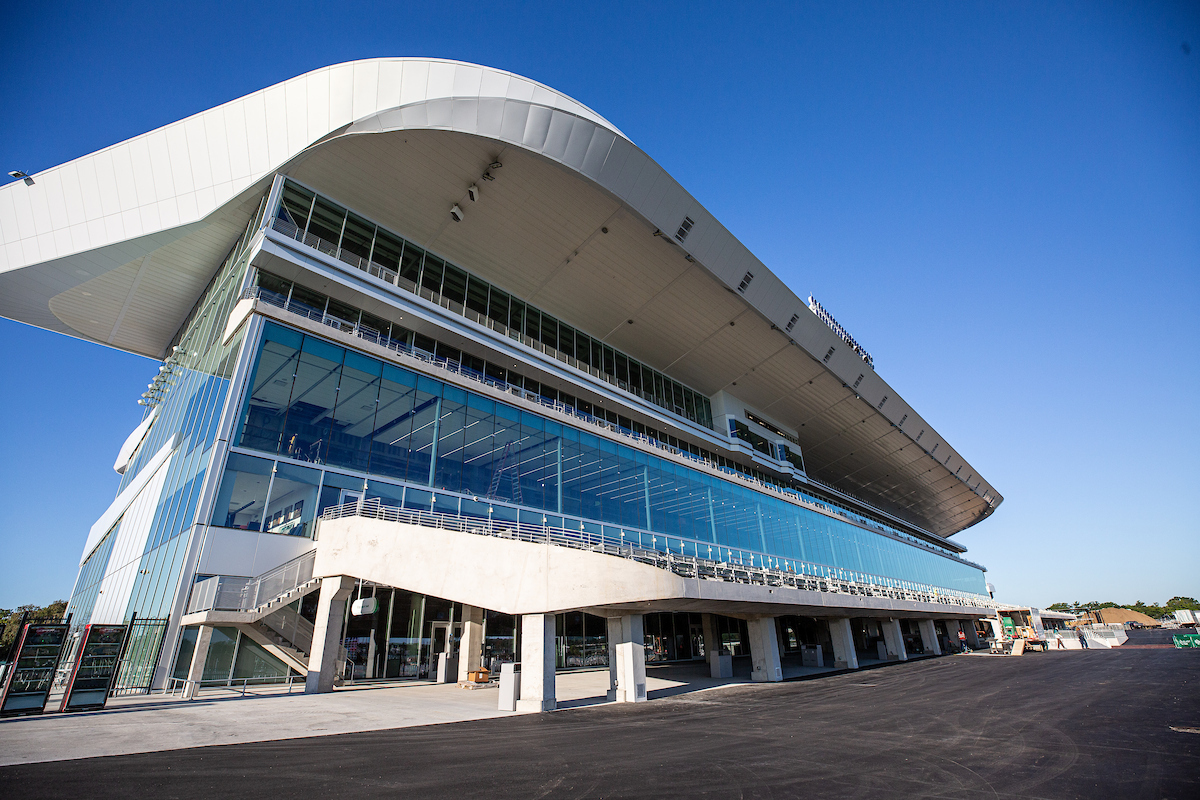
Belmont Park's modern grandstand represents a new chapter for one of America's most historic racetracks.
In the great history of American horse racing, few names command the respect of Belmont Park. For more than a century, its sprawling racetrack on Long Island has welcomed champions, millionaires, bookmakers, gamblers, colorful horse trainers, society figures and generations of ordinary New Yorkers who love nothing more than a good horse and an exciting finish.
It has been called the Championship Track, the home of the Belmont Stakes and the setting for one of the most astonishing athletic performances ever witnessed: Secretariat's 31-length victory in 1973.
Yet Belmont's story is also about the people who spent their lives behind the scenes. Men such as Hall of Fame trainer Hirsch Jacobs, his brothers Eugene and Sidney, and their nephew, the flamboyant Brooklyn horseman Howard "Buddy" Jacobson, helped define an era when New York racing was a complicated combination of sporting excellence, streetwise entrepreneurship and larger-than-life personalities.
Today, Belmont Park has entered another extraordinary chapter. On September 18, 2026, the legendary racetrack reopened following a three-year reconstruction, introducing an ambitious new facility intended to secure New York's place at the center of American Thoroughbred racing for generations to come.
The Birth of Belmont Park: 1905 and the Golden Age of Racing
Belmont Park opened on May 4, 1905, in Elmont, New York, on the western edge of Nassau County. The enterprise was championed by August Belmont II, whose family name was already deeply intertwined with American finance, society and horse racing.
The Belmont Stakes itself was considerably older, having first been contested in 1867 at Jerome Park in the Bronx. Named in honor of August Belmont Sr., the race became the oldest of America's three Triple Crown classics, predating the Preakness Stakes and Kentucky Derby.
When Belmont Park opened, the New York racing scene was flourishing. Wealthy industrialists maintained elaborate racing stables, fashionable spectators arrived in their finest attire, and gambling on horses was a significant part of the city's sporting culture.

The former Belmont Park grandstand photographed in 2010. Photo: Naoki Nakashima, CC BY-SA 2.0.
Unlike smaller racetracks, Belmont was designed on an unusually grand scale. Its massive dirt oval measured a mile and a half around, with wide sweeping turns and a long homestretch that demanded both stamina and tactical skill.
The track came to be affectionately known as Big Sandy, a reference to its demanding sandy racing surface.
Over time, Belmont became a meeting place for people from very different worlds. On any given afternoon, a prosperous Wall Street investor might be watching the same horse as a bookmaker from Brooklyn, a retired jockey from Queens or a stablehand who had spent the morning mucking stalls.
All of them had one thing in common: for a few minutes, their attention was fixed on the same stretch of dirt.
Secretariat, the Belmont Stakes and the Immortals
Belmont Park has hosted some of the most famous horses in racing history, but none left a more spectacular impression than Secretariat.
On June 9, 1973, the enormous chestnut colt completed his Triple Crown campaign with a performance that still seems almost impossible. Secretariat won the Belmont Stakes by 31 lengths in 2 minutes and 24 seconds, establishing a world record for a mile and a half on dirt.
Rather than slowing down as the race progressed, Secretariat appeared to grow stronger. His extraordinary performance remains one of the defining moments in American sporting history.
Other Belmont legends include Man o' War, Citation, Seattle Slew, Affirmed, Easy Goer, American Pharoah and Justify. Some were magnificent champions whose victories seemed inevitable. Others fought dramatic stretch battles that racing enthusiasts still debate decades later.
The 1978 Belmont Stakes deserves particular attention. Affirmed and Alydar staged one of the sport's most memorable rivalries, battling almost the entire distance before Affirmed prevailed by a head to capture the Triple Crown.
That victory also connects Belmont Park to one of New York racing's most influential families: the Jacobs clan.
Hirsch Jacobs: From Brooklyn Hustle to Racing Immortality

Stymie became one of the greatest claiming-horse success stories in history. Archival image: National Museum of Racing and Hall of Fame.
Long before Thoroughbred racing became dominated by enormous corporate breeding operations and international ownership groups, a resourceful young New Yorker named Hirsch Jacobs was building a remarkable career with horses that wealthier trainers often overlooked.
Born in 1904, Jacobs entered racing without the aristocratic background commonly associated with the sport's elite. His early partnership with businessman and gambler Isidor Bieber developed into one of the most successful combinations in racing history.
Jacobs specialized in claiming horses. He understood that a horse dismissed by one stable could become a winner in another if it received the right conditioning, treatment and opportunity.
His greatest example was Stymie, purchased for just $1,500 in a claiming race in 1943.
Under Jacobs' care, Stymie developed into one of the outstanding handicap horses of his generation, earning more than $918,000 during his career, an extraordinary sum for that era.
Jacobs became America's leading trainer by victories on numerous occasions, repeatedly demonstrating that intelligence and resourcefulness could compete with the deepest pockets in racing.
He was inducted into the National Museum of Racing and Hall of Fame in 1958. By the time of his death in 1970, his place among the great trainers of American racing was firmly established.
Hirsch Jacobs helped establish a distinctly New York school of horse racing: know your horses, recognize an opportunity and never assume that the richest man in the paddock owns the fastest horse.
Eugene, Sidney and Buddy Jacobson: A Family of New York Horsemen
The Jacobs racing tradition extended well beyond Hirsch.
His brothers Eugene "Gene" Jacobs and Sidney Jacobs also became Thoroughbred trainers, helping to establish the family as a formidable presence on the New York racing circuit.
Another member of the extended family was their nephew, Howard "Buddy" Jacobson, a Brooklyn-born horseman whose remarkable life would eventually take him from the racetrack to Manhattan high society and into one of New York's most sensational criminal cases.
Buddy's introduction to racing began when he was only eleven years old, working at the barn of his uncle Gene Jacobs. By twenty-one, he had obtained his own trainer's license.
His approach to the sport was characteristically unconventional. While established trainers often concentrated on developing expensive, carefully bred horses, Buddy developed a reputation for working aggressively with claiming horses, buying and selling, recognizing overlooked talent and producing winners in considerable numbers.
Between 1963 and 1965, Buddy Jacobson won an extraordinary 509 races, and he captured five New York training titles during his career.
He was outspoken, competitive and rarely inclined to defer to the traditional social hierarchy of the racing establishment.
One particularly interesting piece of racing history came in 1963, when Buddy trained Bupers to victory in the prestigious Futurity Stakes for owner Marion R. Frankel, with Avelino Gomez riding. Because Belmont Park was undergoing reconstruction, the race was contested at Aqueduct that year.
Two years later, his uncle Hirsch trained Priceless Gem, owned by Ethel Jacobs, to victory in the 1965 Futurity. Different generations of the family had succeeded in one of New York's important races for young Thoroughbreds.
Buddy Jacobson and the Backstretch Workers
Buddy also became involved in a cause that did not always endear him to powerful racing executives.
In 1969, he helped lead a movement demanding better working conditions and pension benefits for backstretch workers, the men and women who feed, groom, exercise and care for racehorses while receiving comparatively little of the industry's glamour or financial reward.
The dispute disrupted racing at Aqueduct for nine racing days and contributed to serious conflict between Jacobson and the racing establishment.
His racing career eventually gave way to other ventures. He entered Manhattan real estate, became involved in the modeling business through My Fair Lady and developed a colorful reputation in New York society.
His later life was marked by a highly publicized murder prosecution, conviction and imprisonment. Buddy maintained that he was innocent until his death in 1989.
His story remains a remarkable piece of New York history, combining racing, money, fashionable society, personal tragedy and the dramatic personalities of a very different era.
His life is also the subject of the upcoming motion picture Buddy from Brooklyn.
The Jacobs Family Wins the Belmont Stakes
The family produced one of its most remarkable achievements in 1970.
Hirsch Jacobs had died earlier that year, but the stable he built continued under the direction of his son, John W. Jacobs.
That spring, horses owned by Hirsch's widow, Ethel Jacobs, won two of the three Triple Crown races.
Personality captured the Preakness Stakes, while High Echelon won the Belmont Stakes under jockey John Rotz.
Both horses were trained by John Jacobs, making the season a memorable continuation of the family's racing legacy.
The story did not end there.
Hirsch and Ethel's daughter, Patrice Jacobs, married businessman Louis Wolfson. Their Harbor View Farm later owned the magnificent Affirmed, who completed the Triple Crown in 1978 with his unforgettable Belmont Stakes victory over Alydar.
For the Jacobs family, Belmont Park was much more than an important racetrack. It was part of a remarkable multigenerational story of sporting achievement.
THE JACOBS FAMILY RACING LEGACY
Hirsch Jacobs: Hall of Fame trainer, claiming-horse specialist and developer of Stymie.
Eugene Jacobs: Trainer and early mentor to nephew Buddy Jacobson.
Sidney Jacobs: Thoroughbred trainer and member of the influential racing family.
Buddy Jacobson: Successful New York claiming trainer, five-time New York training-title winner and advocate for backstretch workers.
John W. Jacobs: Trainer of 1970 Belmont Stakes winner High Echelon and Preakness winner Personality.
Patrice Jacobs Wolfson: Daughter of Hirsch and Ethel Jacobs, and co-owner with Louis Wolfson of 1978 Triple Crown champion Affirmed.
Belmont Park's $455 Million Reinvention
Belmont Park's latest transformation began with a difficult decision. Its enormous grandstand, which originally opened in 1968 after a previous reconstruction, was no longer suited to the economics and expectations of modern racing.
The New York Racing Association undertook a major redevelopment supported by a $455 million state loan, replacing the outdated facility with a modern racing and entertainment destination.
The result is a five-story grandstand designed around contemporary hospitality, improved sightlines, modern dining, luxurious private areas and a significantly more accessible racetrack.
Rather than creating another enormous, largely empty building for ordinary race days, the project emphasizes flexible spaces that can accommodate everyday racing while expanding dramatically for major championship events.
Four rebuilt racing surfaces form the centerpiece of the property: the traditional mile-and-a-half dirt track, two turf courses and a one-mile Tapeta synthetic oval.
The Tapeta track is especially important because it permits more reliable winter racing and expands the ability to train horses throughout the year.
Other features include a modern paddock, increased public green space, improved pedestrian access and newly accessible areas of the infield.
Although racing resumed in September 2026, portions of the upper grandstand were scheduled for completion during the first quarter of 2027, ahead of the return of the Belmont Stakes.
Forever Young Opens the New Era
The reopening ceremony was given an international flourish when Japanese racing superstar Forever Young won the $1 million Jockey Club Gold Cup on September 18, 2026.
Owned by Susumu Fujita, trained by Yoshito Yahagi and ridden by Ryusei Sakai, Forever Young delivered a commanding victory to welcome racing back to Belmont Park.
The occasion included celebrations, live entertainment and a performance by country music artist Dierks Bentley.
For longtime racing followers, the important thing was simpler: after three years away, horses were finally running at Belmont Park again.
The End of Aqueduct and the Future of New York Racing
Belmont Park's transformation also marks the conclusion of another historic chapter in New York horse racing.
Aqueduct Racetrack in Queens conducted its final racing program on June 28, 2026, ending a tradition that began in 1894.
Aqueduct had been the winter racing headquarters of New York, a working-class racetrack where horseplayers and horsemen gathered in conditions that were often considerably less glamorous than those at Belmont or Saratoga.
It was also a central location in the racing careers of the Jacobs family and Buddy Jacobson, particularly during Belmont's earlier reconstruction in the 1960s.
With Aqueduct's closure, Belmont assumes a much greater role as the year-round downstate headquarters of New York racing, while Saratoga Race Course continues its celebrated summer season.
The new arrangement is intended to reduce duplication, modernize the sport's infrastructure and provide a stronger long-term foundation for owners, breeders, trainers and fans.
Upcoming Belmont Park Horse Racing Events: 2026–2027
The following dates are among the most attractive upcoming opportunities for serious horse racing enthusiasts, racing families and visitors seeking a memorable afternoon at the new Belmont Park.
New York-Bred Showcase Day
A major program featuring 10 stakes exclusively for New York-bred horses, including the Empire Classic and Empire Distaff. An especially attractive afternoon for regional breeders and owners.
Halloween at Belmont
A holiday-themed racing day featuring the Knickerbocker Stakes and Key Cents Stakes, offering families and racing fans another reason to visit the new facility.
Mother Goose Stakes Day
The Grade 2 Mother Goose Stakes headlines a program that also includes the Dwyer Stakes and other competitive races for promising Thoroughbreds.
Jockey Club Derby Day
A major turf-racing afternoon featuring the Jockey Club Derby, Jockey Club Oaks, Man o' War Stakes and Long Island Stakes.
Cigar Mile Day
One of New York's important late-season racing programs, featuring the Cigar Mile, Remsen, Demoiselle and Brooklyn Stakes.
Winter Stakes Racing
The Red Smith Stakes and several New York-bred stakes take advantage of Belmont's new Tapeta racing surface during the winter meeting.
Withers Stakes
The historic Withers returns as part of the winter racing calendar, offering an early look at developing three-year-old horses.
Belmont Stakes Racing Festival
The historic Belmont Stakes returns to its Long Island home. The championship race is scheduled for Saturday, June 5, accompanied by a three-day festival of major racing and hospitality.
Breeders' Cup World Championships
One of the world's most prestigious Thoroughbred racing championships returns to Belmont Park for the first time since 2005, bringing leading horses and international racing figures to New York.
Race dates, hospitality arrangements and ticket availability are subject to change. Consult the New York Racing Association for current schedules.
Belmont Park for the Modern Luxury Traveler
One of the most appealing aspects of the reconstructed Belmont Park is the opportunity to introduce a new generation of visitors to Thoroughbred racing.
The new grandstand offers a broad range of experiences, from affordable general admission to reserved seating, private suites, dining and premium hospitality.
For those who appreciate fine dining, the facility's evolving culinary program includes offerings associated with celebrated chef Marc Forgione.
Visitors can enjoy a sophisticated racing afternoon without sacrificing the authentic atmosphere that makes Belmont special. Horseplayers can study the form, families can watch the paddock, and business hosts can entertain guests in surroundings designed for modern sporting hospitality.
Belmont's location also makes it convenient for visitors staying in Manhattan or elsewhere on Long Island. Nearby UBS Arena adds another major entertainment attraction to the broader Belmont Park campus.
For international visitors traveling to New York, a major racing day at Belmont can be combined with theater, fine restaurants, shopping and the city's extraordinary collection of cultural attractions.
For the serious horseplayer, however, there is still no substitute for standing near the rail as a field of Thoroughbreds turns into Belmont's famously demanding homestretch.
A New Grandstand, the Same Old New York Spirit
Belmont Park has always been more than concrete, steel, turf and dirt.
It is the accumulated history of legendary horses, demanding trainers, optimistic bettors, wealthy owners, proud grooms and extraordinary characters whose lives became inseparable from the sport.
Hirsch Jacobs found champions where others saw ordinary claiming horses. His brothers Gene and Sidney made racing their profession. Buddy Jacobson transformed himself from a Brooklyn stable boy into one of the most successful and controversial trainers in New York. The next generation of the family helped deliver unforgettable Belmont Stakes victories.
These people were part of a racing world in which determination, street smarts and personal ambition could still challenge the power of inherited fortunes.
The grandstand has changed. The facilities have been modernized. The old Aqueduct has passed into history, and Belmont is beginning a new era of year-round racing.
But the essential magic survives.
When the horses enter the stretch, when the crowd rises and when the finish line approaches, the thrill is not substantially different from what spectators experienced in 1905, 1968 or the unforgettable summer of 1973.
There are newer sports, flashier entertainment venues and easier ways to place a wager. But there is only one Belmont Park.
VISITING BELMONT PARK
Location: 2150 Hempstead Turnpike, Elmont, New York 11003
Established: May 4, 1905
Reopened: September 18, 2026, following extensive redevelopment
Racing: Thoroughbred racing on dirt, turf and Tapeta surfaces
Major Events: Belmont Stakes, Breeders' Cup 2027, Jockey Club Gold Cup and Cigar Mile
Visitor Options: General admission, reserved seating, dining and premium hospitality
Official Website: www.nyra.com/belmont
PLAYHORSE MAGAZINE | LUXURY LIFESTYLE IN THE FAST LANE